
brettanomyces article 2
Brettanomyces Character in
Wine
©Richard
Gawel
Introduction
The desirability or otherwise of the wine character known as "Brett" is
one of the most controversial issues of recent times. Arguments have
been made for Brett character being a complexing and a legitimate
expression of natural, uncomplicated winemaking, while others view it
simply as an unattractive wine fault that results from poor winery
hygiene and sloppy winemaking.

Figure 1: Brettanomyces bruxellensis forming pseudomycelium
© 2004 High Power Ultrasonics Pty Ltd
The Aroma and
Flavour of Brett Character
But what is Brett character and how and why does it appear in some
wines? The wine character described as "Bretty" comes in various forms.
It is the combined result of the creation of a number of compounds by
the yeast Brettanomyces bruxellensis, and its close relative,
Dekkera bruxulensis. The three most important known aroma active
compounds are 1) 4-ethyl phenol (4-ep), which has been variously
described as having the aromas of Band-aids®, antiseptic and horse
stable 2) 4-ethyl guaiacol (4-eg) which has a rather pleasant aroma of
smoked bacon, spice or cloves and 3) isovaleric acid which has an
unpleasant smell of sweaty animals, cheese and rancidity. Other
characters associated with Brett include wet dog, creosote, burnt beans,
rotting vegetation, plastic and (but not exclusively caused by Brett)
mouse cage aroma and vinegar.
The Formation of
Brett Character in Wine
Brettanomyces has been isolated from the outside of grapes and
from winery equipment. However its, favoured winery haunt is the oak
barrel as it often provides for conditions that strongly favours its
growth.
Certain conditions are known to favour the growth of Brettanomyces
during winemaking. If low free sulfur dioxide levels are coupled with
high wine pH and warm temperatures during barrel maturation, then issues
may arise. If older oak is used and the wine has a reasonable amount of
dissolved oxygen, …. look out! Furthermore it is thought that Brett can
also multiply after bottling if the wine contains residual fermentable
sugars, a situation made more likely if the wine was minimally filtered.
Lets look at the why's of these factors.
Brettanomyces proliferates under warm cellaring conditions.
Twenty degrees C is an ideal temperature, with even small reductions in
temperature seriously hamper its growth. Sulfur dioxide is an
anti-microbial agent that is added by winemakers throughout the
winemaking process. If it is added in sufficient amounts, and the pH of
the wine is reasonably high (SO2 is more effective at higher acidity
levels), then the growth of Brett will be retarded. On the other hand,
high alcohol levels and the existence of even small amounts of
fermentable sugars such as glucose suit the growth of Brett, as they are
its preferred source of energy for growth. Some recent research under
laboratory conditions suggest that Brett does not grow at alcohol levels
above 13%. However, this result is not consistent with the observation
that many wines with alcohols far in excess of this have gone bretty
under winery conditions.
Filtering the wine before bottling can reduce the numbers of Brett
cells, and hence the incidence of Brett character that develops in the
bottle. However, there is anecdotal evidence that filtered wines that
are sound at the time of bottling can randomly become infected with
Brettanomyces after a period of time, probably as a result of the
bottled wine containing residual sugar and being stored in warm
conditions.
It is widely acknowledged that the majority of wines with Brett
character, became that way during the period of barrel maturation,
particularly if second use (or older) oak barrels were used. Brett can
colonise a barrel between fills, and can begin to reproduce when the
barrel is refilled with new wine. Figure 1 shows Brett extending
pseudomycilium into the surface of an oak stave. Topping up barrels with
a wine which contains Brett cells, may also contribute to those barrels
'going Bretty'. Shaving and re-toasting the inside of re-used barrels
significantly reduces the incidence of Brett growth. However, it is also
worth noting that the use of new barrels does not guarantee that Brett
will not appear. Recent work in California has shown that new barrels
filled with sterilised wine can still sustain populations of Brett high
enough to produce above threshold levels of 4-ep.
But why does oak maturation particularly favour Brett growth? Firstly,
Brett is a slow growing yeast that does not compete well against other
micro-organisms. During alcoholic fermentation the wine yeast
Saccharomyces out easily out-competes it. Two possible reasons are that
it naturally grows slower than Saccharomyces, and that it prefers
aerobic conditions for growth. During primary ferment, the wine is
saturated with carbon dioxide which makes for a hostile environment for
Brettanomyces. On the other hand, barrel maturation is a step in
conventional winemaking that provides both the time and the lack of
competition needed for Brett to successfully grow to levels which
results in sensory modification to the wine. Wines stored in barrel are
usually lower in SO2 and are kept warmer than at any other time (other
than during ferment of course). This is necessary so as to encourage
malolactic fermentation (MLF). Lastly, the necessary processes of
racking off lees and regularly topping up barrels ensures that there are
always reasonable levels of dissolved oxygen in the wine. For all these
reasons, it is thought that the time between the completion of primary
fermentation and the start of MLF this is the most likely time that
Brett multiplies and produces brettiness in wine.
Brettanomyces
Character is Seen Primarily in Red Wine. Why?
One
final matter concerning Brett is rarely mentioned. It occurs almost
exclusively in red wines. Why is this so? Red wines have a much higher
level of tannin like substances called coumaric and ferulic acid than do
white wines as they are extracted from the skins of grapes during red
wine fermentation. The wine yeast Saccharomyces and some lactic
acid bacteria such as Lactobacillis have enzymes which degrade
these acids to weakly smelling intermediates called 4-vinyl phenol and
4-vinyl guaiacol (Step 1 of Figure 2). These compounds are then
enzymatically degraded over a period of months by Brettanomyces
to the strong smelling 4-ethyl phenol and 4-ethyl guaiacol respectively
(Step 2 of Figure 2). Incidentally Brettanomyces is the only
major micro-organism in wine that has the ability to transform
4-vinyl-phenol into the potent band-aid® smelling, 4-ethyl phenol. Hence
4-ethyl phenol is rightly considered to be the "trademark" aroma of
Brettanomyces growth in wine. Where you find 4-ethyl phenol you will
invariably find Brett, and vice versa.
Surveys of Australian wines have shown that detectable levels of 4-ethyl
phenol is more likely to be seen in darker coloured wines, with Shiraz
and Cabernet wines than wines made from either Pinot noir and Grenache.
The reason for this is unclear, but may involve the coumarates which are
a form of coloured anthocyanins found in red wines.
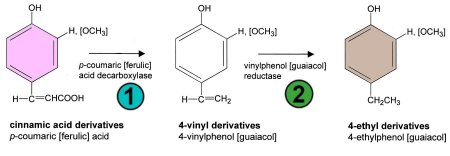
Figure 2: Pathway to the formation of 4-ethyl phenol and 4-ethyl
guaiacol in wine
The Prevalence of
Brett Character
Has Brett character become apparently more prevalent in recent years?
Some commentators believe that we have simply become more aware of it
and that it has always been around. I am sure that there is some truth
in this. Upon personal reflection, I feel that classic Hunter Shiraz
with its 'sweaty saddle' aroma and flavour is a very likely case in
point. However, in my opinion, the overpowering, fruit destroying,
antiseptic like aromas and flavours that are now occasionally
encountered in wines sourced from every winemaking region of Australia
is a relatively new phenomenon. The trend in this country today is to
produce red wines picked from riper grapes. In addition to maximizing
flavour development in some varieties, this also results in wines that
are on average higher in pH and alcohol. Furthermore, residual sweetness
is being retained in some commercial red wines in an attempt to fill out
the palate and to give it greater apparent fruitiness. These trends
together with the use of minimal SO2 and filtration, has enhanced the
conditions under which Brett is retained and thrives.
The Desirability
or Otherwise of Brett Character in Wine
But is the action of Brett desirable? In my humble opinion, the answer
depends on degree. As well as producing a band-aid aroma, Brett can
create an array of 'interesting' smells that can excite those that are
inclined to be excited by them. Furthermore, the ratio of the rather
unattractive 4-ethyl phenol to the rather pleasant smelling 4-ethyl
guaiacol varies substantially from wine to wine, with reports varying
from 3:1 to over 40:1. In the latter case, it is highly likely that the
wine would smell like the inside of a band-aid box, while in the former,
the aroma would in all likelihood be far more spicy and savoury like.
The reason for these differences between wines are not completely
understood but are likely to be either due to differing ratios between
wines coumaric and ferulic acids (the respective precursors of 4-ep and
4-eg), or to different strains of Brettanomyces being more effective in
producing one compound relative to the other. Very recent research with
five different strains of Brettanomyces has not lent much support to the
latter possibility. Under laboratory conditions the different strains
produced roughly equal proportions of 4-ep to 4-eg in the same red wine.
But the search for strains of Brett which may be low 4-ep producers will
no doubt continue.
In some wine growing regions such as Bordeaux, the Rhone and, dare I say
it, the Hunter Valley, it is now acknowledged that some wine producers
have developed 'house styles' over time that have actually been defined
by some form of Brett character. Many of these producers, or the media,
or both, have naively attributed these unusual and sometimes complexing
characters to being 'an expression of the soil'. However, overwhelming
scientific evidence in the form of elevated 4-ethyl phenol levels in
their wines have forced them to admit to the less romantic notions of
the microbiological origin of these characters. This is not to say that
they necessarily will, or indeed should, do anything different in the
future, as many Bretty house styles have become widely accepted and in
some cases revered by the wine tasting public. But in the cases where a
wine smells more of a hospital ward than it does wine, surely the
wine-maker should begin to reflect on what wine drinkers seriously
value. That is, real fruit and real complexity. Unfortunately some
winemakers (possibly in an attempt to save their career), have
attributed the accidental making of overtly Bretty wines as a serious
attempt at making something different and complex. Wine diversity is a
wonderful thing and should be encouraged in the face of continued
'internationalisation' of wines. But as Pascal Chattonet once argued.
Brettyiness has nothing to do with a wines 'typicity' as claimed by some
French wine producers. His counterclaim is that wines that are overly
Bretty do indeed smell and taste much the same, so overt Brettyness
mitigates against 'typicity' and diversity. I'm in Pascal's camp. Real 'typicity'
and 'expression' indeed come from the fruit. A message that I hope is
not lost on the winemaking fraternity.
This
work was presented at the Australian Society of Wine Education National
Convention. Hunter Valley, Australia. 4th-6th of June 2004.
www.aswe.org.au